Breakwater engineering gives Newbiggin Reborn a technical framework for reducing wave force, stabilising beach material, and protecting public assets. It connects marine surveys, structural design, armour placement, settlement control, and post storm monitoring into one disciplined process. Newbiggin Bay offers a useful case because its offshore defence combined geotextile, rock core, concrete armour, and beach recharge.
Technical Principles Behind Breakwater engineering Design
A breakwater must be designed from the sea outward, not from the promenade alone. Engineers study wave climate, seabed levels, sediment movement, storm exposure, tidal range, and existing sea defences before choosing a structure. At Newbiggin, the offshore solution helped retain imported sand and reduce pressure on the inner shoreline after years of erosion. Good design therefore treats the structure, beach, sea wall, and public realm as one connected coastal system.

Breakwater engineering And Shoreline Stability
The main role of a breakwater is to lower the energy reaching the coast before waves strike vulnerable assets. When offshore force is reduced, nourished sand has a better chance of remaining inside the bay. This improves the defensive value of the beach while preserving space for walking, photography, and family recreation. Shoreline stability should be judged through repeated surveys, not only by how calm the water appears on a single day.
Material Based Types Of Breakwater Structures
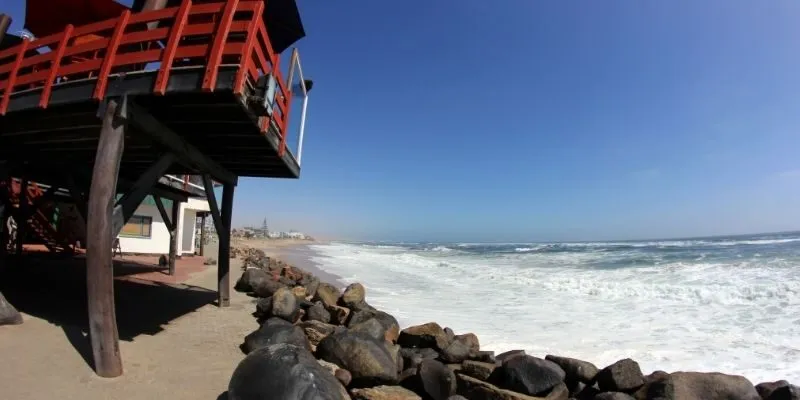
Breakwaters can use natural rock, concrete armour units, caissons, geotextile systems, or mixed layered construction. Rock armour offers mass and a natural appearance, while concrete units can provide stronger interlocking behaviour where space or wave energy demands it. Newbiggin used geotextile fabric, rock core, Coreloc concrete armour, and a rock toe in a layered arrangement. Breakwater engineering selects these options by balancing loading, cost, constructability, maintenance, and landscape impact.
Wave Dynamics And Structural Load Calculation
Wave loads depend on height, period, direction, water depth, overtopping risk, and storm return conditions. Designers calculate how waves will break, reflect, run up, and transfer force through armour layers into the core. If armour is undersized, individual units can move, exposing smaller stones and increasing failure risk. Breakwater engineering must therefore include safety factors, model checks, and allowance for future climate pressure.
Seabed Foundation Studies And Settlement Control
A marine structure can fail if the seabed beneath it is not understood. Surveys should test sediment strength, scour potential, soft spots, slope stability, and the likelihood of long term settlement. Geotextile fabric can separate seabed material from placed rock, improving stability at the base. Settlement markers, bathymetric checks, and post storm inspections help confirm whether the foundation continues performing as expected.
Mathematical Simulation And Wave Tank Testing
Numerical models help predict wave transformation, current changes, and sediment response before construction begins. Physical wave tank testing can then examine armour movement, overtopping, toe scour, and breakwater shape under controlled storm conditions. Combining both methods reduces uncertainty because models reveal patterns while physical tests expose practical weaknesses. Breakwater engineering gains reliability when calculations are challenged before expensive offshore placement begins.
Construction Workflow And Quality Control For Breakwater engineering
Construction quality depends on placing the right material in the right order under difficult marine conditions. Newbiggin records show that work began with geotextile fabric and rock core before protective armour was added. Around 60,000 tonnes of rock and concrete armour were used for the offshore structure, showing the scale of coordination required. Every stage needs survey control, weather windows, marine safety, and documented inspection before the next layer covers it.
Quarry Planning And Protective Armour Selection
Quarry planning should confirm stone durability, density, grading, shape, availability, transport route, and testing certificates before delivery. Concrete armour units require separate checks for mix design, curing, dimensions, surface defects, and lifting points. Newbiggin used 3.9 cubic metre Coreloc units and a five tonne rock armour toe to strengthen exposed zones. Breakwater engineering depends on material traceability because one weak batch can create expensive repair risks later.
GPS Positioning And Rock Level Control
Offshore placement requires accurate positioning because misplaced core material can distort the final profile. Crews can use GPS, echo sounders, crane controls, and as built surveys to confirm levels after each working shift. The toe must sit correctly because it supports the armour slope against scour and sliding. Clear tolerances reduce rework and prevent hidden defects from being buried beneath heavier layers.
Working During Harsh Weather And Heavy Seas
Marine contractors must plan around wind, waves, tide, visibility, and vessel stability. A schedule should define safe limits for lifting, dumping, surveying, and diving before crews enter exposed areas. Weather stoppages may frustrate public expectations, but rushed placement can damage quality and safety. Breakwater engineering treats downtime as a risk to manage honestly rather than a reason to ignore marine conditions.
Monitoring Deformation, Toe Scour, And Settlement
Monitoring should continue after completion because strong storms can shift armour, expose toe material, or create scour pockets. Inspections may use divers, sonar, drones, fixed photographs, and comparison surveys after severe events. A practical standard is to inspect within 48 hours after major storms and publish two condition summaries yearly. Breakwater engineering becomes credible when maintenance decisions are based on visible evidence instead of optimistic assumptions.
Ecological Breakwater Trends And Sustainable Development
Rough surfaces, voids, tide pools, and carefully designed armour can support algae, shellfish, small invertebrates, and fish around a structure. Sustainable planning should also consider quarry distance, concrete use, construction emissions, inspection access, and future repair needs. Breakwater engineering can therefore protect people while creating opportunities for environmental learning and better coastal stewardship.
For Newbiggin, ecological value should be measured rather than claimed from photographs alone. Monitoring can record colonisation on armour surfaces, water clarity, bird activity, invasive species risk, sediment movement, and public education use. Suggested targets include two ecological checks each year, six fixed photo points, and public reporting after severe storm seasons.
Conclusion
Breakwater engineering gives Newbiggin Reborn a rigorous way to connect wave reduction, seabed stability, armour design, construction quality, ecological monitoring, and long term coastal resilience. The Newbiggin example shows why geotextile layers, rock core, Coreloc units, accurate placement, and beach recharge must operate as one integrated system. Future Breakwater Construction value will depend on inspection discipline, climate readiness, transparent reporting, and repair decisions made before defects become failures.